


 Dec 20, 2025
 3 min read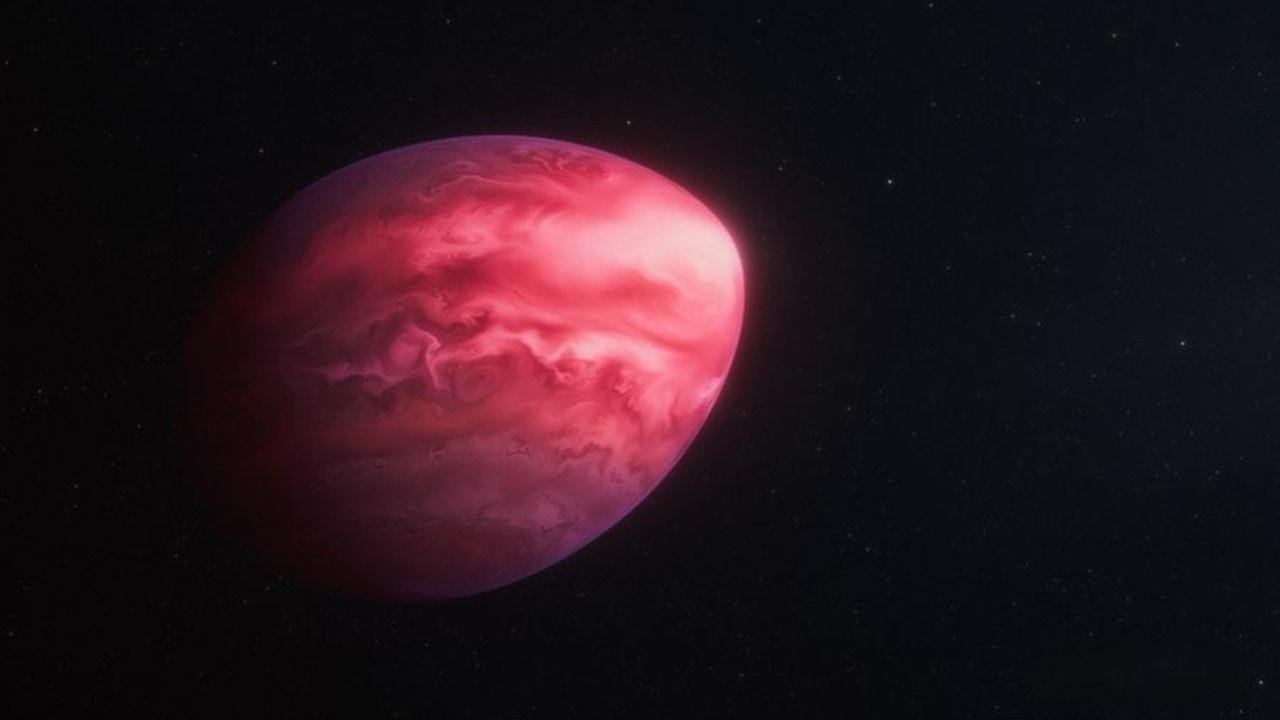
This new extrasolar planet observed by the James Webb Space Telescope orbits a 'black widow pulsar' that consumes it.
NASA spotted a lemon-shaped space with an inexplicable artifact: 'What the hell is this?'
This new planet outside the Solar System, observed by the James Webb Space Telescope, orbits a 'black widow pulsar' that is engulfing it
More than 6,000 exoplanets (worlds outside the solar system) have been discovered, of which the atmospheres of about 150 have been studied, but none were as rare as the one recently discovered by the James Webb Space Telescope.Its shape is similar to the shape of a lemon and its atmosphere is so different from any other that NASA cannot explain how such a planet existed.The study was published this Tuesday in The Astrophysical Journal Letters.
This new world, called PSR J2322-2650b, orbits a pulsar (a rapidly rotating neutron star) and has about the same mass as Jupiter.This system falls into the category of "black widow pulsars", destroying the star's smaller, low-mass satellite with the radiation it bombards it with.
Why is the PSR J2322-2650b like a lemon?
This connection and proximity results in the exoplanet's elliptical shape.The gravity of the much more massive pulsar deforms it, giving it the strange shape of a lemon or an American football.It should be taken into account that from an astronomical point of view, the distance between them is very small.PSR J2322-2650b is 1.6 million kilometers from its star, while Earth orbits 160 million kilometers from the sun.
"It was definitely a surprise. I remember, after downloading the data, our collective reaction was: 'What is this?'" study co-author Peter Gao of the Carnegie Earth and Planetary Laboratory in Washington said in a NASA statement. "This is very different from what we expected."
Pulsar Gemsar allows the Web Explanet Watch in detail
A planet orbiting a pulsar is favorable for its study."This system is unique because the planet is illuminated by the star, but we don't see the star. This gives us a really clean spectrum. We can study this system in more detail than normal exoplanets," explains Maya Belesne, a third-year PhD student at Stanford University (California).
A neutron star emits electromagnetic radiation containing gamma rays and other high-energy particles every few milliseconds or seconds, but these are invisible to Webb's infrared vision.Because the star does not interfere with the instruments of the telescope, it is possible to study the planet in its entire universe.
The first extraterrestrial planet with a carbon molecular atmosphere
But what most caught the attention of NASA scientists was the atmosphere, dominated by helium and carbon, and unlike anything seen before.They believe carbon and carbon that can condense to form diamonds are likely to form soot clouds floating in the atmosphere.
"This is a new type of planetary atmosphere that no one has seen before. Michael Zhang from the University of Chicago, the principal investigator of this study, instead of finding the usual molecules that we expect in an exoplanet, such as water, methane and carbon dioxide, we saw molecular carbon, especially C3 and C2'.
Scientists say the discovery of molecular carbon is highly unusual because at PSR J2322-2650b's temperature (2,038 °C on the day side, 649 °C on the night side), carbon must be bound to some other type of atom.In fact, this is the first time that detectable molecular carbon has been detected in any of the exoplanets studied.
NASA doesn't know how to do it
“Does this shape look like a regular planet?No. Because of its completely different composition, it was created by stripping away the outer layers of the star. Is the Black Widow system "normal" or not?Impossible. Since nuclear physics does not produce pure carbon, it is very difficult to imagine how this carbon-rich element was obtained."It seems to rule out all known formation mechanisms," Zhang said.
The team is confused by the features of PSR J2322-2650B.The other co-author of the study, Roger Romani of Stanford University and the Kavli Institute for Astrophysics and Cosmology of particles, guess what might happen in this atmosphere: "As the companion cools, the mixture of carbon and oxygen inside begins to crystallize.Keeping the mystery something.
Log in to your account to comment
21-D: campaign closing keys