

 Dec 21, 2025
 3 min read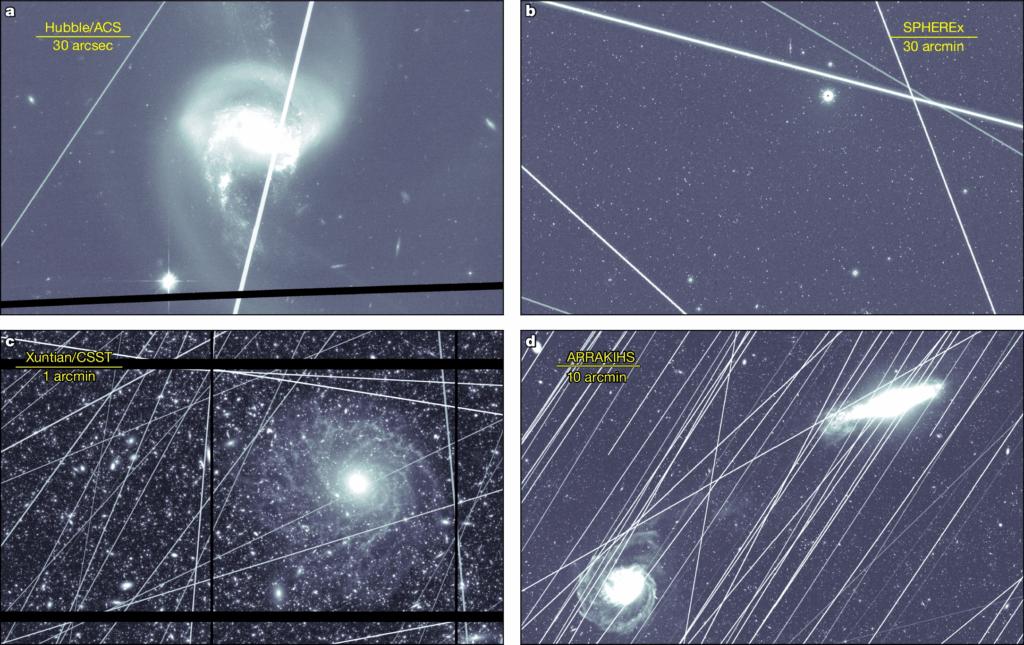
More than five years ago, when people started talking about the impact giant satellites would have on astronomical observations, the response from many, including Elon Musk himself, was that telescopes should be moved to space.Needless to say, the cost of space telescopes is an order of magnitude higher than that of ground-based telescopes.Can we really be sure that space telescopes in Earth orbit will not be seriously affected? A recent article in Nature by Alejandro Borluff, Pamela Markham, and Steve Howell confirms that simply moving telescopes to low earth orbit (LEO) is not actually enough.
Right now the problem is not that big.But remember, we're not just talking about Starlink: several constellations are starting to be deployed right now, such as Amazon Leo (formerly Kuiper) or China's SatNet and SpaceSail, among others.Many more will be implemented in the next decade.It is estimated that the current number of satellitesWith approximately 9,400 Starlinks currently in orbit, that's only 3% of the number of satellites that will be available in the next ten years. By 2040, there could be nearly half a million satellites in orbit in LEO (!), given the large number of objects in space.Up to a third of Hubble's images will be affected by satellite tracking.(Even though Hubble is no longer in useThis conclusion applies to any space telescope.in fact, 4.3% of Hubble images taken between 2018 and 2021, which are still very few satellitesIt is already contaminated.
And keep in mind that Hubble has a relatively small field of view compared to the new generation of telescopes equipped with larger sensors, many of which are focused on sky-wide surveys.As a result, all-sky missions such as NASA's SPHEREx Infrared Observatory, the Chinese Xuntian Space Telescope or the European ARRAKIHS satellite to study dark matter are seriously contaminated by satellite tracks;tip: The article reminds us that the new Starlink v2 Mini is larger at 126 square meters compared to the v1.5 and v1.0's 26 square meters, and in particular the DTC (Direct to Cell) rows are brighter, with a visual magnitude between 0 and 1, compared to the previous one's 4-6 points.Remember that an object above magnitude 6 is invisible to the human eye, but it is recommended that satellites are not smaller than magnitude 7 to avoid saturation of many sensor pixels.
The authors of the article calculated that there are 560,000 satellites in low orbit, Hubble images will average 2.14 satellite tracks, while SPHEREX will have 5.64, ARRAKIHS around 69 and Xuntian, 92. The solution?Of course, and as we have been demanding on this blog for more than five years now, an international legal framework is needed which does not exist or is not expected at present.It helps to reduce the average orbital length of the satellite - although, with caution, some operators like Starlink choose this option not because of their concern about astronomy (or not only), but to reduce the delay of communication - but, in return, it creates problems such as contamination of the atmosphere by metal oxides - it is possible to damage the ozone layer - or the effect they can have - in this atmosphere.
The best solution, of course, is to move astronomical telescopes beyond LEO, to the ESML2 Lagrange point, for example, where observatories such as JWST or Euclid are already located.But sending a satellite 1.5 million miles from Earth presents other problems related to communication or the cost of the mission (you need a bigger rocket).Will megaconstellations kill low-level guardians?This seems to be the opposite.
In fact, the new generation of ground-based telescopes, particularly Vera C.Megaconstellations are also influencing the Rubin Observatory's wide images.However, we must always remember the observatory's self-published articles and press releases that say they have no problem with Starlink at this time.If they have them with Starlink or other mega constellations in the future, we will have to respond that they should be quiet and not disturb them, that it was already too late and they didn't respond when they could have protested.An answer that could also be extended to other observatories, they didn't want to talk when they could.
The excessive exploitation of a resource sooner or later leads to an environmental disaster.For example, mega-mining of copper pollutes a population's water sources, and here mega-satellite constellations pollute LEO.And the silence of governments fuels the disaster.
And the opening of O.T.
Jared Isaacman confirmed as NASA administrator
I would open the thread and say it's 'fire'!I was going about it though
Pff!So even LEO is not an option against megaconstellations...
Well, it's a big deal...we have to get a tight grip on it or it's going to become a serious political issue.